
Aluminium and thick-copper boards
Two different answers to the same problem: a board that has to move heat, or carry current, that a 1 oz FR-4 layer cannot. Aluminium spreads the heat; heavy copper carries it. Both change what the rest of the board is allowed to do.
- Copper0.5 – 12 oz
- Layers1 – 32
- Thickness0.2 – 8.0 mm
- Metal claddingListed process
Two problems, two materials
Heat leaves a board by three routes: through the copper, into the air, and into whatever the board is bolted to. These two families attack different ones.
An aluminium-base board attacks the third route. A metal core under the dielectric spreads heat sideways across the whole board instead of letting it pile up under the hot part, and it gives the assembly a large, flat surface to escape from. LED modules, power supplies and any board that is bolted to a metal housing use them for that reason — the enclosure is part of the thermal design, and the board is the interface to it.
Thick copper attacks the first route. At 4 oz, 6 oz or 10 oz, a copper layer carries more current with less resistive loss and less temperature rise than the 1 oz layer on a standard board, and it doubles as a heatsink for the parts sitting on it. Where an aluminium core needs a metal substrate and a restricted layout, heavy copper keeps an ordinary FR-4 stackup and changes only the copper.
Our fabrication list covers both: aluminium is one of the base materials, copper weight runs from 0.5 oz to 12 oz, and metal cladding is on the special-process list. What decides which one you need is the thermal calculation — how many watts, over what area, into what — and that is on the drawing before it is on the quote.
Aluminium and heavy copper limits
Same plant, same quality standard, different substrate and different copper.
| Copper weight | 0.5 oz – 12 oz |
| Base material | FR4, CEM1, CEM3, High TG, Rogers, F4B, Taconic, FR1, FR2, 94V0, aluminium |
| Layer count | 1 – 32 layers |
| Board thickness | 0.2 – 8.0 mm ± 10% |
| Maximum board dimensions | 650 mm × 1,100 mm (25.6 in × 43.3 in) |
| Minimum line width / spacing | 0.06 mm / 0.06 mm — house minimum, see the note below |
| Minimum drill hole diameter | 0.1 mm |
| Minimum slot width | 3.0 mm (0.12 in / 120 mil) |
| Metal cladding | On the special-process list — a metal layer added for current or thermal reasons |
| Board cutting | Shear, V-score, tab-routed, countersunk |
| Special processes | Half holes, bonding, impedance control, metal cladding, resin plug holes, blue glue, carbon ink, blind routing, blind and buried vias |
| Surface finish | HASL, ENIG, immersion tin, immersion silver, OSP, ENEPIG, electrolytic hard gold, gold fingers, ENIG + OSP |
| Quality standard | IPC-A-600F / MIL-STD-105D |
| Design files accepted | Gerber RS-274X and 274D, KiCad, Eagle, Altium/Pro-E, AutoCAD DXF and DWG |
| Order quantity | 1 – 500,000 |
| Lead time | Prototype 3–4 days; mass production 8–16 days |
Read that last line carefully if your design has fine lines and heavy copper on the same layer. Heavy copper is etched from thicker laminate, and the finest line a layer will hold falls as the copper gets thicker — 0.06 mm is the house minimum, not a promise for every copper weight. Send the drawing and we will tell you what that layer etches before you commit to a layout.
What changes when the core is metal
Three mechanical facts that decide the layout, well before anyone asks for a price.
Vias are restricted. A hole through an aluminium core cannot be plated the way a hole through FR-4 is: the core has to be cleared and the barrel insulated from it. That is why metal-core boards are usually single-sided or two-layer with a small via count, and why a design that needs a dense via field usually belongs on thick copper instead.
It is routed, not scored. Aluminium does not V-score cleanly, so metal-core outlines come out on the router, tab-routed, or with the edges machined. Board cutting — shear, V-score, tab-routed, countersunk — is on the process list, but which of those you get depends on the substrate.
It expands differently. Aluminium expands faster than the dielectric it carries, and the difference is what stresses the joints on a board that sees thermal cycling. On boards with large parts, that is a layout question: keep the parts near the middle, and keep the dielectric thickness uniform under them.
For a board where the current, the copper and the spacings are all set by the same thermal calculation, the power electronics note takes it through the drawing decisions one at a time.
Where aluminium and heavy copper fit, and where they do not
Aluminium or thick copper is right if…
You want a different family if…
Heat and current are drawing decisions — by the time a board is quoted, the thermal path is fixed. Compare the five board types if you are still choosing the substrate.
Same plant, other families: FR-4 and high-TG rigid · HDI build-up · flexible and rigid-flex · high-frequency laminates.
Common questions
What copper weights do you build?
0.5 to 12 ounces. Copper weight is chosen per layer, so a heavy plane and 1 oz signal layers on the same board is a normal request rather than a special one.
Do you build aluminium (metal-core) boards?
Yes. Aluminium is on our base-material list alongside FR4, CEM1, CEM3, high TG, Rogers, F4B, Taconic, FR1, FR2 and 94V0.
Why does the minimum line width change with copper weight?
Because heavy copper is etched from thicker laminate, and a thick layer will not hold a fine line. 0.06 millimetres is the house minimum rather than a promise for every copper weight — send the drawing and we will confirm what that layer etches.
Can an aluminium board carry components?
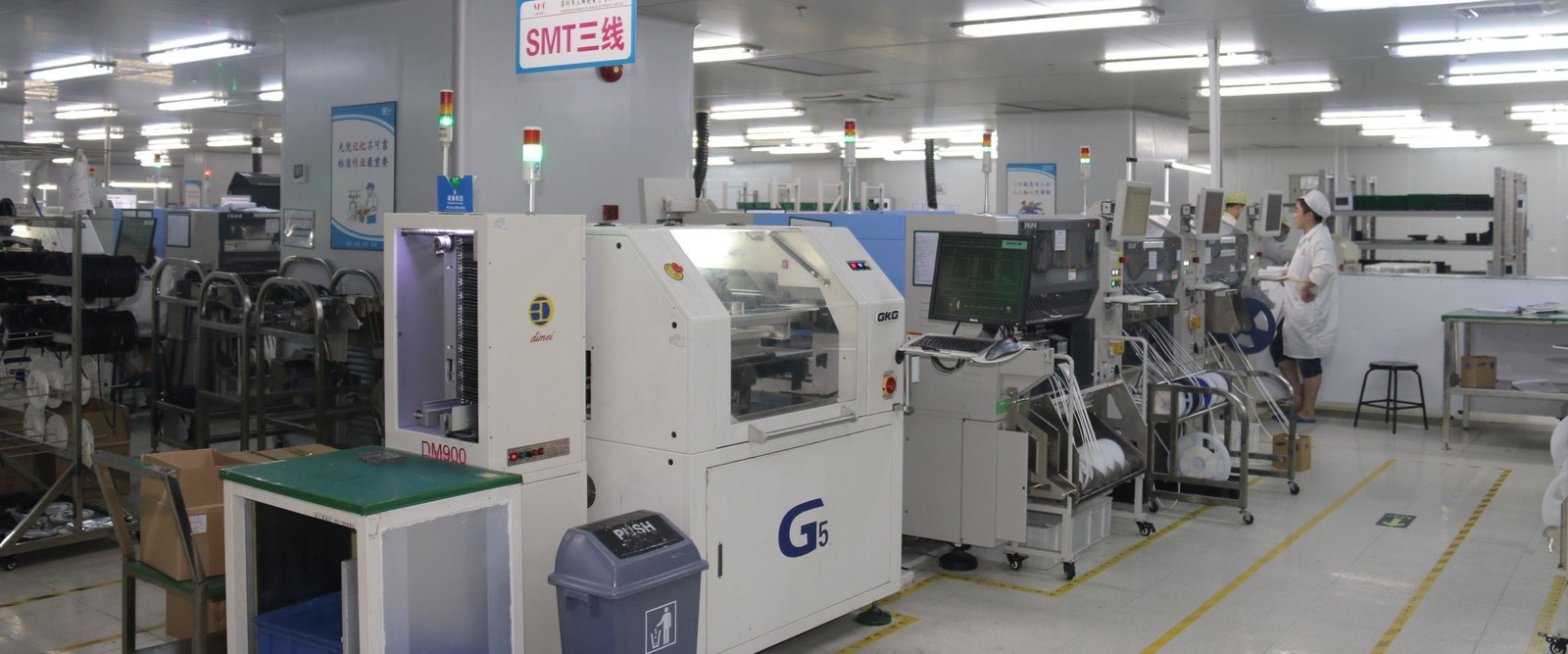
Yes. The assembly limits are the same as for any board: up to 450 by 470 millimetres on 24 SMT lines, components from 01005 to 2512, BGA pitch down to 0.3 millimetres.
How do I send a heavy-copper design?
Send the Gerber (RS-274X or 274D) or the native files, state the copper weight per layer, and mark which nets carry the current. The copper weight is what decides the etch and therefore the price, so it cannot be left to the fab to guess.
Heat is a drawing problem
By the time a board is quoted, the thermal path has already been decided. Send the stackup with the current per layer and the copper weight is confirmed before the price is.