

The board types we build, and what each one is for
Five families cover almost everything a buyer needs to price: FR-4 rigid, flexible and rigid-flex, aluminium and thick copper, high-frequency laminate, and HDI. Each family has its own page with the limits we actually hold, the decisions that change the price, and the cases where a different board is the cheaper answer.
- Board families5
- Layers1 – 32
- Thickness0.2 – 8.0 mm
- Max board650 × 1,100 mm
Which board type you actually need
Read the second column first. What decides the choice is almost never the laminate name.
| Board type | What decides the choice | Our range | Where it goes wrong |
|---|---|---|---|
| FR-4 rigid | Layer count, copper weight and finish | 1–32 layers, 0.5–12 oz, 0.2–8.0 mm | Fine lines ordered on a stackup that never gave them a reference plane |
| Flexible / rigid-flex | How many lamination cycles the construction needs | 1–32 layers, bonding, 0.06 mm lines | A rigid board design that someone then asked to fold |
| Aluminium / thick copper | How much heat or current has to move | Copper 0.5–12 oz, aluminium core | Copper weight chosen for current, then routed at fine pitch |
| High-frequency | Dk, Df, and the stackup the laminate forces | Rogers, Taconic, F4B, impedance control | FR-4 kept for a design that already fails at the connector |
| HDI | Microvia stackup and BGA pitch | Laser holes to 0.075 mm, 0.3 mm BGA pitch | Build-up layers added to rescue routing that needed a better stackup |
All five families come from the same fabrication list, on the same 1 to 32 layer range and the same 650 × 1,100 mm maximum board. The difference between them is what the board has to survive, not which supplier carries which material.
The five families
Grouped by what the board has to do. Each page gives the limits we hold, the decisions that change the price, and the cases where a different board is the cheaper answer.
Rigid boards
Laminated substrate that does not move. Three of the five families sit here, and what separates them is what the board has to do that plain FR-4 cannot.
FR-4 rigid boards
The default laminate, and the one most quotes are really about. 1 to 32 layers, 0.2–8.0 mm thick, copper to 12 oz, high TG when the board is reflowed twice.
Board type 02High-frequency boards
Rogers, Taconic and F4B laminate for designs where the dielectric constant and the loss tangent decide whether the signal arrives at all.
Board type 03HDI and microvias
Laser-drilled vias down to 0.075 mm and build-up layers, which is what a 0.4 mm-pitch BGA usually needs before the routing closes.
Flexible and metal-core
Where the board stops being a flat piece of material and becomes part of the mechanics: it folds, or it carries heat and current.
Flexible and rigid-flex
A flex tail laminated into a rigid board. The copper has to survive being bent, and every extra lamination cycle is another chance of delamination.
Board type 05Aluminium and thick copper
Two answers to the same problem. A metal core spreads heat across the board; 4 oz to 12 oz copper carries current with less loss and less temperature rise.
What to send, and what comes back
The file list is the same for all five families.
Every one of them is quoted from the same four things: the Gerber (RS-274X or 274D) or the native design files (KiCad, Eagle, Altium or Pro-E, AutoCAD DXF and DWG), the stackup, the quantity, and the surface finish. Send those and what comes back is a price rather than a range, usually within 24 hours. What a quote actually needs goes through the list in more detail.
Two limits apply whatever the board type. Fabrication goes to 650 × 1,100 mm. A board that also carries components is limited by the SMT line to 450 × 470 mm — a board built at the full fabrication size carries 3.4 times the area assembly can take. If your design is larger than the assembly limit, tell us before you order and we will confirm how it is panelised. The full parameter table, including tolerances and finishes, is on the fabrication page.
Common questions
How many board types do you build?
Five families: FR-4 rigid, flexible and rigid-flex, aluminium and thick copper, high-frequency laminate, and HDI. All five run from 1 to 32 layers, between 0.2 and 8.0 millimetres finished thickness, on boards up to 650 by 1,100 millimetres, from a single piece.
Which board type should I choose?
Whichever the application forces, rather than the best one on a datasheet. Start from what the board has to do: fold, carry current, move heat, or hold an edge rate above a few gigahertz. If none of those applies, FR-4 is the cheaper and better-understood answer, and a higher-grade laminate buys nothing.
Do all five run through the same assembly line?
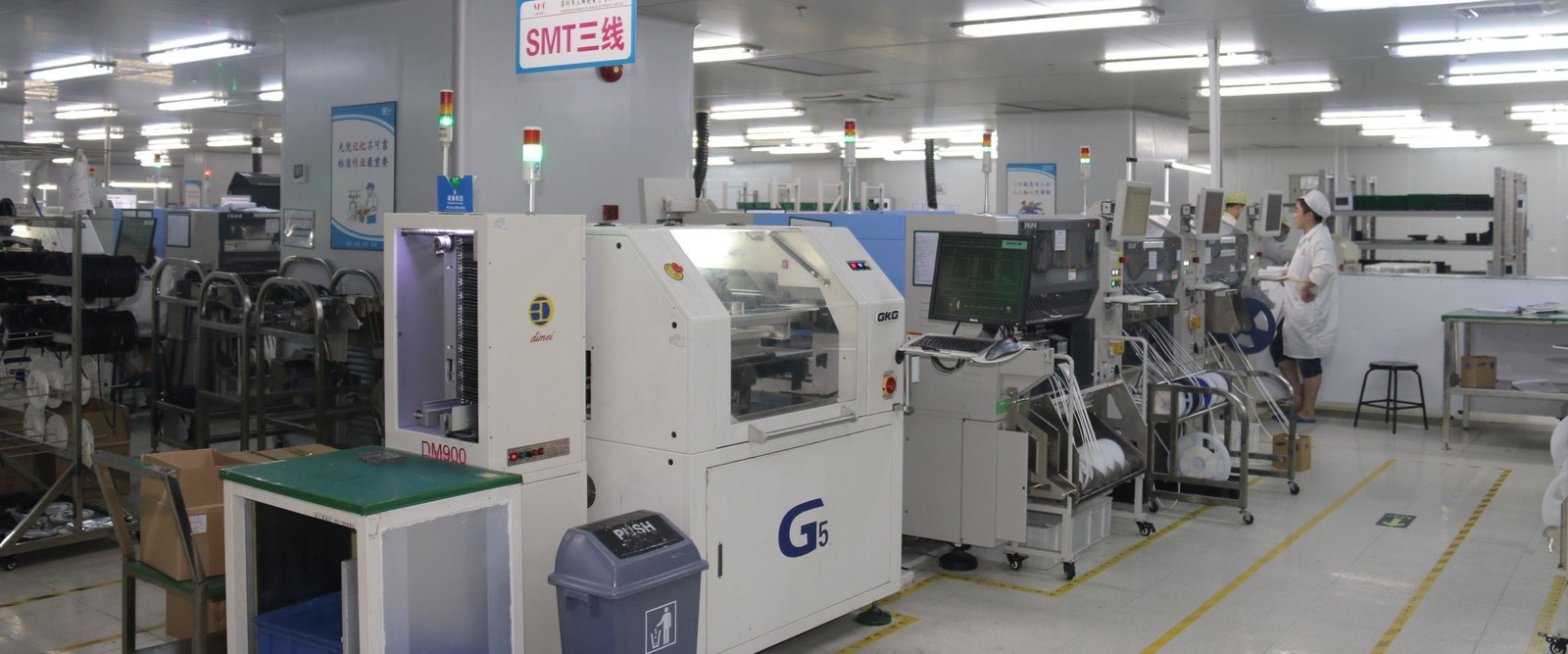
Yes. Assembly is limited by the SMT line rather than by the laminate: boards up to 450 by 470 millimetres, 24 SMT lines, 40.39 million placement points a day, components from 01005 to 2512 and BGA pitch down to 0.3 millimetres.
Not sure which of the five your design is?
Send the Gerber and the BOM. Telling you which family a board belongs to — and whether a cheaper one would do — takes less time than quoting it.