PCB vs PCBA: the difference, and why it changes your quote
One is a component. The other is an assembly with a bill of materials, a test step and a second clock. The difference decides which standard inspects the work, which unit you are quoted in, and who owns a defect when a board fails.
- Bare board standardIPC-A-600
- Assembly standardIPC-A-610
- Priced byArea vs points
- Minimum order1 piece
The difference in one sentence, and the three things it decides
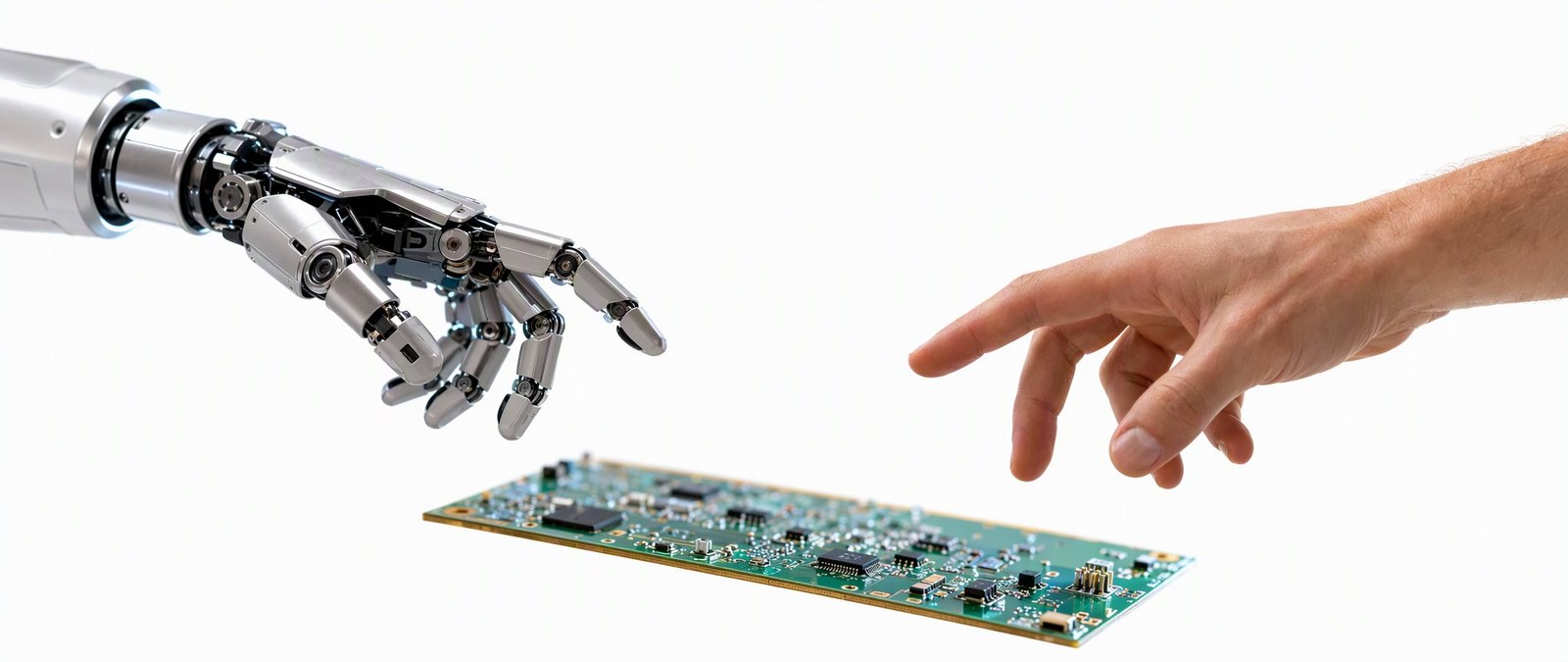
A PCB is a piece of processed laminate: the copper that carries the current, the mask that keeps solder off it, and the finish that keeps the copper solderable. A PCBA is a product: that board plus the components, the solder joints, the programming if there is any, and the test record that says it works.
That single difference decides three things buyers usually discover too late:
- Which standard inspects it. Bare boards are judged against IPC-A-600; assemblies against IPC-A-610. They are different documents, and one does not imply the other.
- Which unit the price is built from. A board is priced by area, layer count and finish. An assembly is priced by placement points, plus the components, plus one-time setup.
- Who is accountable. With a bare board there is one party. With an assembly there is a parts supplier, a fabrication house and an assembler — unless one supplier owns all three.
Why IPC-A-600 and IPC-A-610 are not interchangeable
IPC-A-600 is the acceptability standard for printed boards. It tells an inspector what a plated hole, a trace edge or a mask dam should look like before anything is assembled. The Class 1 / 2 / 3 distinction for bare boards lives in a different document, IPC-6012, which is the qualification specification the board is built to.
IPC-A-610 is the acceptability standard for assemblies. It governs fillets, voiding, placement and the three workmanship classes that people usually mean when they say “Class III”.
The practical consequence is small but expensive: a supplier who says “Class III” may only mean the assembly. If your product is regulated, write both requirements into the purchase order — IPC-6012 Class 3 for the bare board, IPC-A-610 Class III for the assembly — and ask to see both on the first article. What each class actually changes on the line is covered separately.
Bare board and assembly, side by side
Read the row that matters to your decision: if you are choosing a supplier, the last two rows decide more than the first four.
| Bare PCB | PCBA | |
|---|---|---|
| What it is | Laminate, copper, solder mask and finish. No components. | That board plus components, solder joints, programming and test records. |
| Standard | IPC-A-600 for acceptability; IPC-6012 for the Class 1–3 build. | IPC-A-610 for acceptability and the Class 1–3 workmanship level. |
| Priced by | Area, layer count, surface finish, quantity. | Placement points, component cost, stencils and programming. |
| Lead time here | 3–4 days prototype, 8–16 days production, 24 hours expedited. | 7 days up to 5 units, 14 days up to 1,000, 21 days up to 10,000. |
| What is tested | Electrical test for opens and shorts; inner-layer AOI. | SPI, AOI, X-ray, ICT or flying probe, then functional test. |
| Size limit | 650 × 1,100 mm | 450 × 470 mm through SMT |
| Who owns a defect | The fabrication house. | Whoever sourced the parts and ran the line. |
The two size limits are not the same number: a bare board can be 650 × 1,100 mm, but a board that also goes through SMT is limited to 450 × 470 mm. That is 3.4 times the area, and the single most common sizing mistake in a first enquiry.
Where buyers mix the two up
“A Class III board” is not a thing
Classes live in IPC-6012 for bare boards and in IPC-A-610 for assemblies. Asking for “Class III” without naming the standard usually gets you the cheaper interpretation, because the supplier is free to apply it to the assembly only.
“Add assembly to the board price”
Assembly is not a markup on the board. On a typical 100-piece run the bare board is often one fifth of the PCBA price or less; the rest is components, stencils, programming and test fixtures. Quoting the board first and the assembly second hides most of the money until the BOM arrives.
“PCBA is just a PCB with parts on it”
The parts are the risk. Allocation, minimum reels, counterfeits and one long-lead line item can set the date for the whole order, and none of that appears on a fabrication quote. If the board is the easy half, the BOM is the half that decides whether the date holds.
Which one are you actually buying?
- Bare board only. You or a local EMS assembles it. Perfectly normal, and we take it from one piece with the electrical test report and the stackup.
- Consignment. You send the parts, we assemble and test. You keep control of the BOM and carry the parts risk yourself.
- Turnkey. We buy, assemble and test. One clock, one owner, and usually the shortest path to a working unit.
Turnkey vs. split suppliers compares the three on cost, and what to send for a quote covers the files either way.
Common questions
Is a PCBA more expensive than a PCB?
Yes, usually by several times, and not because assembly is expensive. Components are the bulk of a PCBA price; on a 100-piece run the bare board is often one fifth of the total or less. The rest is parts, one-time setup, stencils and test.
Can you make the bare board and let me assemble it elsewhere?
Yes. Bare-board orders are welcome from one piece and ship with the electrical test report and the stackup, so your assembler has what it needs for its own first-article check.
Does a Class III assembly need a Class III bare board?
No. They are separate requirements in separate standards. If your customer’s drawing calls for both, specify IPC-6012 Class 3 for the board and IPC-A-610 Class III for the assembly, and ask for both on the first article.
What is the minimum order for each?
One piece, either way. There is no minimum order quantity on bare boards or on assembly, which is the point of running both under one roof.
Related guides
What IPC-A-610 Class III actually requires
The difference between Class I, II and III, and which products genuinely need the strictest one.
What to send for a PCBA quote
The three files a quote cannot be made without, and the four that turn an estimate into a price.
How long does PCBA take?
Where the weeks actually go, and which stage is setting your date.